Timing is one of the most consequential—and easily oversimplified—subjects in a menopause appointment. The ELITE trial tested whether oral estradiol affected an arterial imaging measurement differently when treatment began relatively soon after menopause rather than much later. Its central finding supported a timing-dependent effect on that measurement. It did not establish that starting estrogen early prevents heart attacks, nor did it turn years since menopause into a stand-alone prescribing rule.
The distinction comes from the study’s design: 643 healthy postmenopausal women received estradiol or placebo within two predefined timing groups, with a median follow-up of five years. Researchers repeatedly measured carotid artery-wall thickness and separately assessed coronary arteries using computed tomography. Understanding which result changed, which did not, and which outcomes were not established makes ELITE more useful for a clinical conversation than a simple early-versus-late slogan.
Study facts at a glance
Population and assignment: ELITE randomized 643 healthy postmenopausal women to estradiol or placebo within groups less than six years or at least ten years since menopause. Source 1
Studied treatment: The active regimen used oral 17β-estradiol; women with a uterus also received sequential vaginal progesterone. This was not a patch trial. Source 1
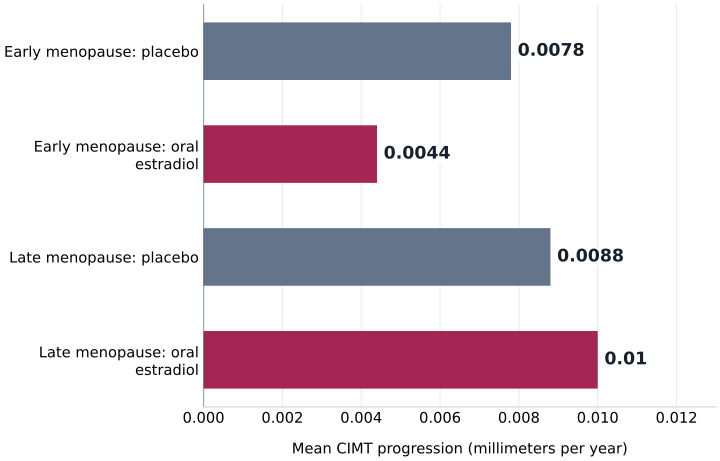
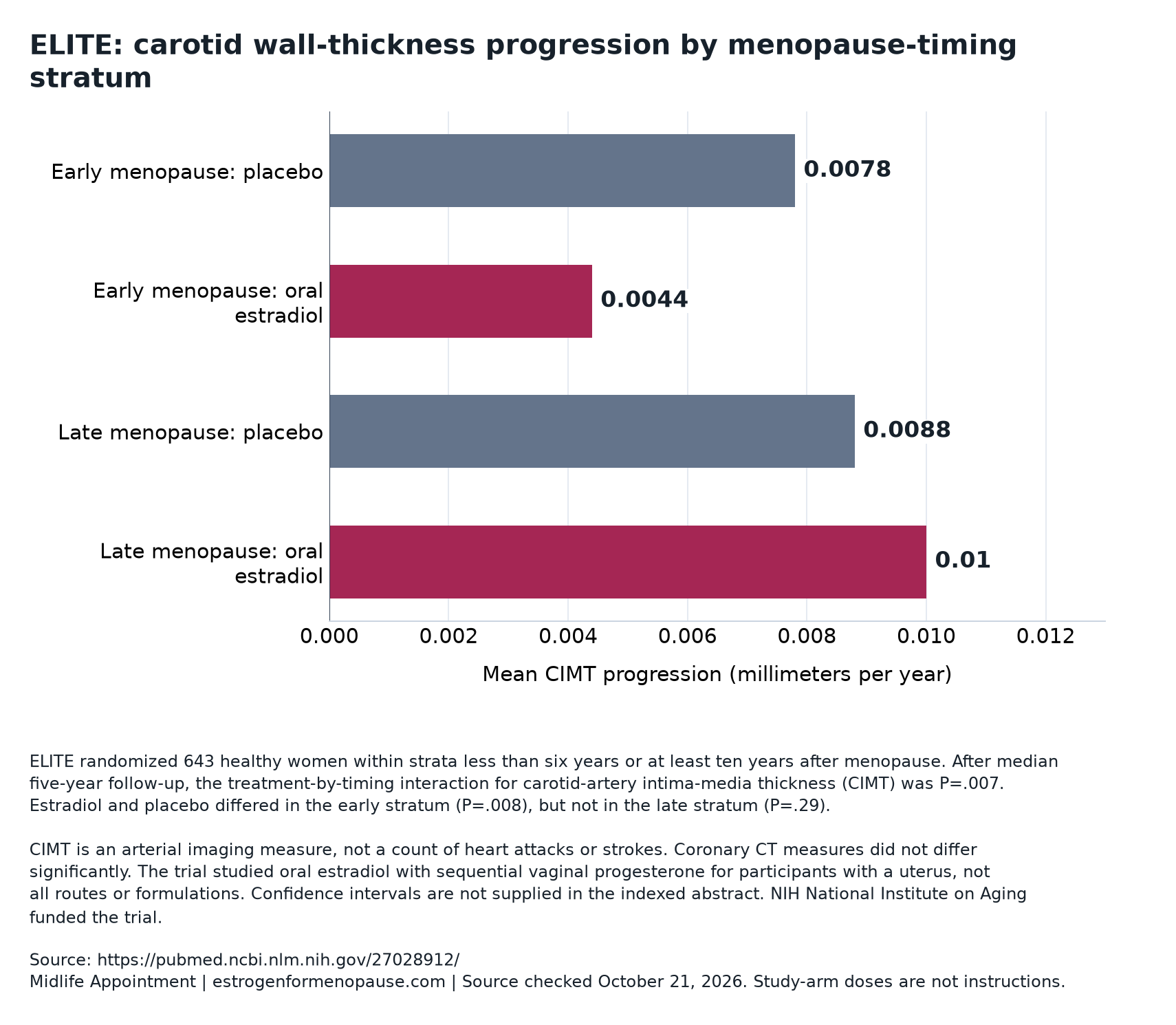
Earlier timing group: Mean carotid intima-media thickness increased by 0.0078 mm/year with placebo and 0.0044 mm/year with estradiol, a difference of 0.0034 mm/year. Source 1
Timing interaction: Treatment effects on carotid thickening differed between timing groups, with an interaction P value of 0.007; coronary CT findings did not differ significantly in either group. Source 1
Current labeling context: The 2026 FDA boxed-warning changes did not erase product-specific contraindications or establish hormone therapy as cardiovascular prevention. Source 4 Source 2
What ELITE actually randomized
ELITE separated participants into two strata, meaning groups defined before treatment assignment: less than six years since menopause and at least ten years since menopause. Within those strata, women were randomly assigned to active treatment or placebo. Randomization therefore supported comparisons between treatment and placebo within each timing group.
The investigators did not randomly assign women to experience menopause earlier or to wait a decade before treatment. That matters when interpreting why the treatment effects differed. The study tested treatment in two existing populations; it did not isolate elapsed time from every other characteristic that might distinguish earlier from later postmenopause.
The population was described as healthy, not as women selected for established cardiovascular disease. Follow-up lasted a median of five years, meaning that this was the middle follow-up duration rather than an identical observation period for everyone. The National Institute on Aging at the National Institutes of Health funded the trial. These design features make ELITE a focused test of a vascular hypothesis, not a general assessment of every menopause treatment goal.
Read the underlying chart data: download CSV or download the source-labeled chart.
The regimen was specific, including progesterone’s route
The estradiol arm received oral 17β-estradiol at 1 mg daily. Women with a uterus also received 45 mg progesterone vaginal gel daily for ten days in each 30-day cycle. The placebo arm used corresponding placebo treatment, including sequential placebo vaginal gel for women with a uterus. These doses describe the experimental arms, not a treatment recommendation.
The intervention was therefore not identical for every participant: uterine status determined whether progesterone was included. The reported estradiol comparison encompasses treatment with or without that progesterone regimen. It cannot separately establish how much progesterone contributed to the imaging findings, because progesterone’s independent effect was not the randomized comparison described in the abstract.
Nor was ELITE a head-to-head test of oral estradiol against a skin patch. A modern combined oral capsule also differs from oral estradiol paired with intermittent vaginal progesterone. Ingredient names alone do not make products or schedules interchangeable. Findings cannot automatically be transferred to compounded preparations, other routes, or services selling hormone care.
The primary endpoint measured artery walls, not heart attacks
The primary outcome was the rate of change in carotid-artery intima-media thickness, abbreviated CIMT. This measurement describes the thickness of layers in the carotid artery wall. Researchers obtained measurements every six months, allowing them to compare the pace of change rather than relying only on one final scan.
CIMT is a surrogate endpoint: a biological measurement used to investigate disease processes instead of directly counting clinical outcomes such as heart attacks. ELITE’s report used it to assess subclinical atherosclerosis, meaning arterial disease detectable before a clinical event. An intervention’s effect on this measurement does not itself quantify its effect on heart attacks, stroke, or survival.
Repeated imaging is valuable because it can reveal a treatment-related difference in vascular progression during a manageable study period. But the units remain millimeters per year. Translating those units into an individual’s chance of avoiding a heart attack would require evidence connecting the treatment-induced imaging change to clinical events. ELITE’s indexed abstract does not provide that translation.
Reading the early and late results in their original units
Among women less than six years since menopause, mean CIMT increased in both treatment groups. Progression was slower with estradiol: 0.0044 mm/year compared with 0.0078 mm/year with placebo, with P=0.008. The finding was slower thickening, not demonstrated reversal of the measured arterial change.
Subtracting the rates gives an estradiol-minus-placebo difference of −0.0034 mm/year. Dividing that difference’s magnitude by the placebo rate gives approximately 44% slower progression of this measurement. That arithmetic does not mean a 44% reduction in cardiovascular risk. Neither percentage points of disease probability nor a number needed to treat can be derived from these imaging rates.
In the group at least ten years since menopause, the corresponding rates were 0.0100 mm/year with estradiol and 0.0088 mm/year with placebo. The numerical difference pointed toward faster progression with estradiol, but it was not statistically significant, with P=0.29. The abstract supplies no confidence intervals for these rate estimates, limiting assessment of their precision.
ELITE’s carotid imaging results, with all rates expressed in millimeters per year
| Timing group | Reported mean progression | Interpretation |
|---|---|---|
| Less than 6 years since menopause | Placebo 0.0078; estradiol 0.0044 | Estradiol-minus-placebo difference −0.0034; P=0.008 |
| At least 10 years since menopause | Placebo 0.0088; estradiol 0.0100 | Estradiol-minus-placebo difference +0.0012; P=0.29 |
| Comparison of treatment effects across strata | Interaction P=0.007 | Evidence that the treatment effect on CIMT differed by timing group |
Why the interaction is more informative than two separate P values
A common statistical mistake is to conclude that two groups differ merely because one treatment comparison is significant and the other is not. ELITE reported a more relevant test: the interaction between treatment and timing stratum. Its P value of 0.007 provided evidence that estradiol’s effect on CIMT progression differed between the two timing groups.
An interaction asks whether the treatment-versus-placebo contrast changes across groups. It does not establish the biological mechanism responsible, and it does not mean every woman in the earlier group experienced benefit. Group mean progression can differ while individual responses vary. The abstract does not supply participant-level response distributions or detailed subgroup findings.
The timing definitions also leave an important gap: the trial’s strata were less than six years and at least ten years since menopause. They do not directly map the intervening years or identify a sharp biological deadline. The later-start conversation guide can help organize timing questions, but ELITE’s boundaries should not be mistaken for a universal treatment cutoff.
Coronary CT did not confirm a broader imaging benefit
ELITE also assessed coronary atherosclerosis by cardiac computed tomography when participants completed their assigned regimen. These secondary outcomes examined coronary-artery calcium, total stenosis, and plaque. Stenosis refers to narrowing; these measurements addressed the arteries supplying the heart rather than the carotid artery-wall endpoint.
None of those CT measures differed significantly between estradiol and placebo in either timing stratum. This prevents a straightforward claim that early estradiol improved arterial imaging throughout the cardiovascular system. The positive primary finding and the nonsignificant secondary findings need to remain visible together.
The abstract does not report numerical CT treatment effects or confidence intervals. Consequently, it is not possible from this account to determine how large a coronary effect the data could reasonably exclude. Nonsignificance is not proof of equivalence. Nevertheless, the reported results offer no significant coronary CT improvement to support extending the CIMT finding into a general claim of coronary protection.
WHI answers different questions about different treatments
The Women’s Health Initiative provides important context, but it is not another version of ELITE. Its long-term breast outcome report followed two separate placebo-controlled randomized populations totaling 27,347 women, with a baseline mean age of 63.4 years. Women with prior hysterectomy received conjugated equine estrogen alone; women with a uterus received conjugated equine estrogen plus medroxyprogesterone acetate.
After more than 20 years of median cumulative follow-up, estrogen alone was associated with lower breast cancer incidence, with a hazard ratio of 0.78 and 95% confidence interval of 0.65–0.93. The combined regimen was associated with higher incidence: hazard ratio 1.28, confidence interval 1.13–1.45. A hazard ratio compares event rates over follow-up, not an individual’s cumulative probability.
These were different populations, not a three-arm comparison proving that adding a particular progestogen caused the contrast. Active intervention lasted medians of 7.2 and 5.6 years, not the entire long follow-up. The WHI long-term breast outcomes analysis examines these distinctions. Neither its breast findings nor ELITE’s carotid result supplies a complete benefit-harm profile for a different formulation.
Three evidence sources that should not be treated as interchangeable
| Evidence | Treatment and comparison | Main question relevant here |
|---|---|---|
| ELITE | Oral estradiol, plus sequential vaginal progesterone when a uterus was present, versus placebo | Does timing modify carotid wall-thickness progression? |
| WHI long-term breast report | CEE alone after hysterectomy or CEE plus MPA with a uterus, each versus placebo in separate trials | What were breast cancer incidence and mortality after prior randomized treatment? |
| BIJUVA label’s symptom substudy | Combined oral estradiol/progesterone capsules versus placebo | Did moderate to severe hot-flash frequency and severity improve at weeks 4 and 12? |
Safety evidence requires a separate accounting
ELITE’s indexed abstract does not provide detailed adverse-event counts, participant flow, or treatment discontinuations. That limits this analysis: a favorable primary imaging result cannot substitute for a safety assessment. Absence of an adverse-event table in the accessible abstract is not evidence that adverse events did not occur.
The current BIJUVA label supplies actual safety findings for a different oral estradiol/progesterone formulation. In its one-year safety study, breast tenderness occurred in 4.0% of 424 women receiving the 0.5 mg/100 mg capsule and 10.4% of 415 receiving the 1 mg/100 mg capsule, versus 0.7% of 151 receiving placebo. Headache occurred in 4.0%, 3.4%, and 0.7%, respectively. Those percentages do not estimate adverse effects of ELITE’s regimen.
In the label’s biopsy-evaluable population, endometrial hyperplasia occurred in one of 303 women and one of 281 women in the two approved-dose groups, versus none of 92 receiving placebo. No endometrial cancers were observed in those groups during the study, which does not establish long-term cancer prevention. A bleeding-history guide addresses why unexplained bleeding belongs in the assessment rather than being treated as a minor administrative detail.
The 2026 labeling change did not create a prevention indication
On February 12, 2026, FDA announced approved labeling changes for an initial six menopausal hormone products. Statements about cardiovascular disease, breast cancer, and probable dementia were removed from their boxed warnings. That announcement did not establish that every marketed product’s label had already changed, and removal from a box is not equivalent to declaring a risk absent.
The current BIJUVA label retains cardiovascular and malignancy warnings and contraindications. These include breast cancer or its history, unexplained abnormal genital bleeding, active or previous venous blood clots or arterial thromboembolic disease, liver disease, and known thrombophilic disorders. The product is indicated for moderate to severe menopausal vasomotor symptoms in women with a uterus, not cardiovascular prevention.
The label says timing may affect the overall risk-benefit profile, while also stating that cardiovascular-prevention safety and efficacy have not been established. Those positions are compatible: a timing-sensitive treatment discussion need not imply preventive prescribing. The hot-flash and sleep goals guide helps keep the clinical objective explicit rather than letting an imaging finding silently replace the reason for seeking care.
Bringing the evidence into a midlife appointment
ELITE supports asking a precise question: how does time since menopause affect interpretation of evidence for the treatment being considered? It does not answer whether a particular person should start therapy, whether a patch would reproduce the result, or whether an imaging difference outweighs other outcomes. Symptoms, uterine status, medical history, formulation, and the outcome of interest remain distinct parts of the discussion.
Editorial interpretation: when comparing care arrangements, the practical value is an opportunity to examine those distinctions, not a promise of artery protection. The online menopause care comparison guide can help frame that process. For documentary details, the Midi review and Evernow review offer starting points for checking written consultation, follow-up, and payment terms; neither link establishes access to the studied regimen or trial-like outcomes.
Several scientific questions remain open in this evidence: whether the CIMT difference predicts fewer clinical events, what happens between the two timing strata, how other formulations compare, and what the full long-term benefit-harm balance looks like. Answering those questions requires outcome-specific evidence. Extending a five-year annualized imaging rate across a lifetime would not resolve them.
Questions about the evidence
Did ELITE show that estradiol prevents heart attacks?
No. Its primary endpoint was carotid artery-wall thickness progression, not heart attack incidence. The earlier timing group had slower progression with estradiol, but coronary CT measures did not differ significantly. There is no supported conversion from the observed millimeters-per-year difference to a reduction in heart attacks.
Does the late-group finding prove that starting later damages arteries?
No. Progression was numerically greater with estradiol in the late group, but the treatment comparison was not statistically significant. Without the confidence interval, the abstract does not show the range of effects compatible with those data. The stronger finding was that treatment effects differed between timing strata.
Why not apply ELITE directly to an estradiol patch?
ELITE randomized oral estradiol against placebo, with sequential vaginal progesterone for women with a uterus. It did not compare oral treatment with a patch. Shared hormone ingredients do not establish equal vascular effects across routes, doses, or progesterone schedules, and the trial provides no head-to-head estimate.
Did FDA’s warning revision overturn the original trial findings?
No. A labeling revision changes how regulatory information is presented; it does not erase observations from randomized trials. FDA’s initial 2026 announcement covered six products. Current product-specific contraindications and remaining warnings still matter, and the BIJUVA label does not establish cardiovascular-prevention efficacy.
What evidence was available for this analysis?
The analysis uses the indexed primary report abstracts for ELITE and the WHI long-term breast study, together with the available official BIJUVA prescribing information and FDA announcement material. It does not claim review of the trials’ full articles, protocols, or supplements. ELITE’s abstract omits detailed safety results and confidence intervals.
What this evidence supports
ELITE offers randomized evidence that oral estradiol’s effect on carotid wall-thickness progression differed between women less than six years and women at least ten years since menopause. Its positive early-group result is scientifically meaningful within that endpoint, particularly because the interaction was formally tested. The nonsignificant coronary CT findings prevent treating it as a consistent benefit across vascular imaging measures. For a menopause appointment, the useful conclusion is that population, timing, formulation, and measured outcome must stay connected—not that early treatment is a proven cardiovascular-prevention strategy.
Research access and limitations
ELITE and WHI interpretation here is abstract-based. ELITE’s accessible report does not provide confidence intervals for CIMT rates, numerical CT effects, detailed adverse events, or participant flow. Safety data from the BIJUVA label concern a different regimen and cannot fill those trial-specific gaps.
Read alongside the article
Sources & notes.
These sources provide provider descriptions or medical context. They do not replace an individual clinical assessment.
- Vascular Effects of Early versus Late Postmenopausal Treatment with Estradiol. ↗Indexed primary study abstract · Checked 2026-10-21
- DailyMed: BIJUVA estradiol and progesterone capsule prescribing information ↗Full official prescribing information · Checked 2026-10-21
- Association of Menopausal Hormone Therapy With Breast Cancer Incidence and Mortality During Long-term Follow-up of the Women's Health Initiative Randomized Clinical Trials. ↗Indexed primary study abstract · Checked 2026-10-21
- FDA: Initial six menopausal hormone therapy labeling changes approved February 12, 2026 ↗US regulator labeling announcement · Checked 2026-10-21