The long-term Women’s Health Initiative breast cancer report does not deliver one verdict on all menopause hormone therapy. It follows two separate randomized trials: estrogen alone in women who had undergone hysterectomy, and estrogen plus a progestin in women with a uterus. Compared with their respective placebo groups, the trials produced different breast cancer findings. Those differences matter, but they are not a direct comparison of the two treatments.
The report also distinguishes treatment from observation. Median assigned treatment lasted 7.2 years in the estrogen-alone trial and 5.6 years in the combination trial; cumulative follow-up extended beyond 20 years. Understanding that timeline, the actual formulations, and the uncertainty around deaths makes the findings more useful in a menopause discussion than either reassurance or alarm based on a headline.
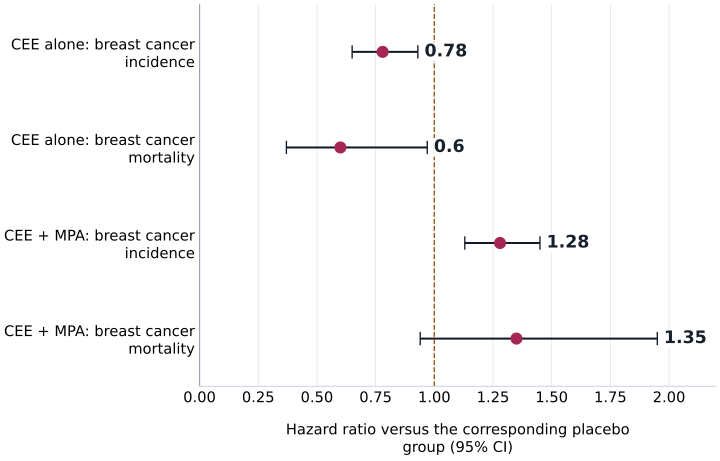
Study facts at a glance
Two randomized populations: The trials included 10,739 women with prior hysterectomy and 16,608 women with a uterus, each with its own placebo comparison. Source 1
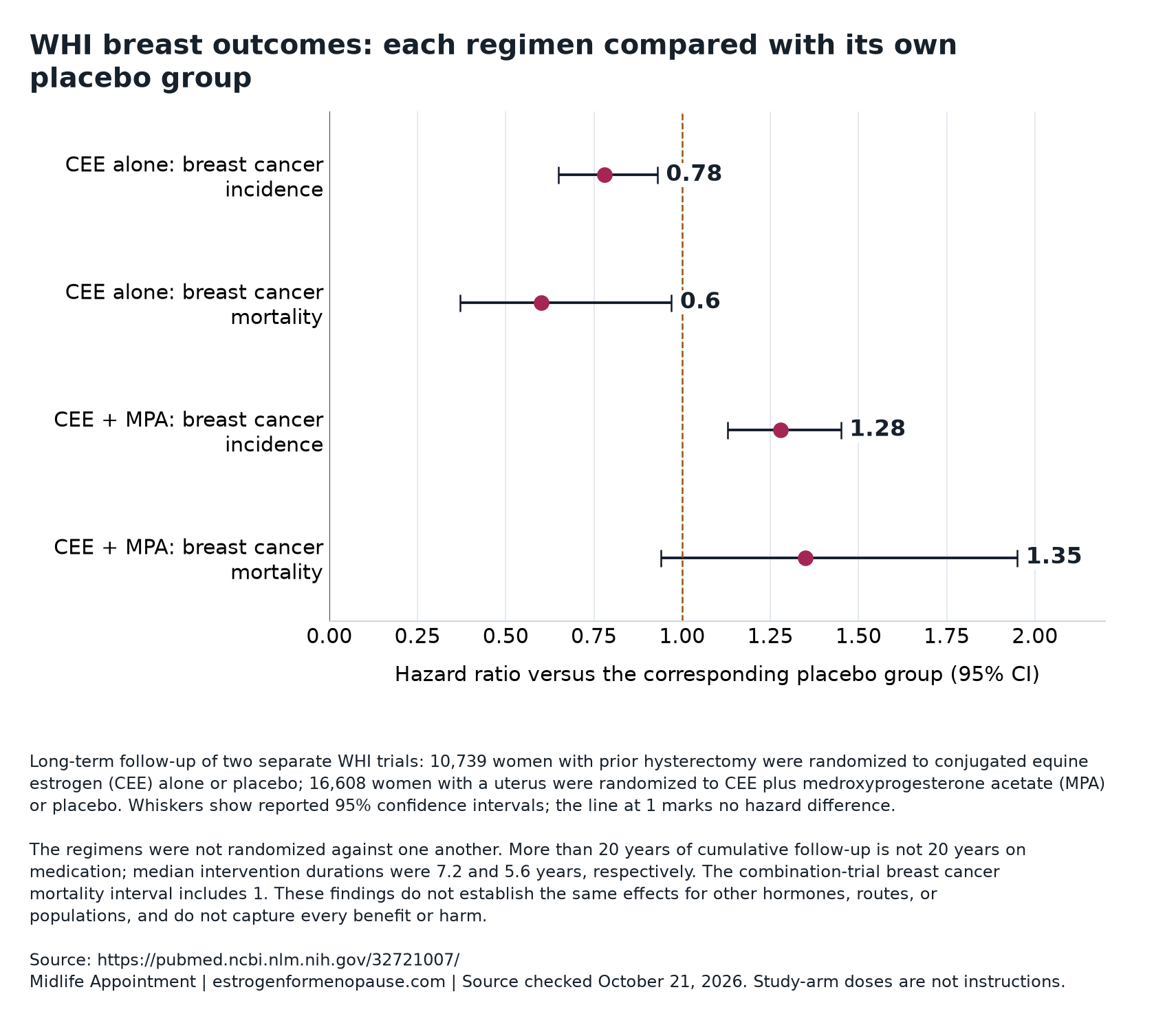
Estrogen-alone incidence: CEE alone was associated with lower breast cancer incidence: hazard ratio 0.78, with a 95% confidence interval of 0.65–0.93. Source 1
Combination incidence: CEE plus MPA was associated with higher breast cancer incidence: hazard ratio 1.28, with a 95% confidence interval of 1.13–1.45. Source 1
Breast cancer deaths: Breast cancer mortality was significantly lower with CEE alone; the combination trial’s mortality estimate was higher but not statistically significant. Source 1
Current labeling context: FDA announced boxed-warning changes for an initial six hormone products in February 2026; product-specific contraindications and other warnings still matter. Source 4 Source 2
Start with who entered each trial
WHI enrolled 27,347 postmenopausal women at 40 US centers from 1993 through 1998. Participants were 50–79 years old, with a mean baseline age of 63.4 years. They had no prior breast cancer and a negative screening mammogram at entry. These entry conditions define the population behind the estimates; the report does not test treatment in breast cancer survivors.
Uterine history determined which trial a participant entered. Among women with prior hysterectomy, 5,310 were randomized to conjugated equine estrogen, abbreviated CEE, and 5,429 to placebo. Among women with a uterus, 8,506 were randomized to CEE plus medroxyprogesterone acetate, abbreviated MPA, and 8,102 to placebo.
Randomization supports comparisons within each trial, not between the two active-treatment groups. Women were not randomly assigned to have or not have a uterus. For appointment preparation, the bleeding-history guide offers a practical place to organize that part of the history, while the study explains why uterine status cannot be treated as a minor detail.
Read the underlying chart data: download CSV or download the source-labeled chart.
More than 20 years of follow-up was not 20 years of medication
The estrogen-alone arm used oral CEE at 0.625 mg daily. The combination arm used oral CEE at 0.625 mg plus MPA at 2.5 mg daily. These doses identify the research regimens, not instructions for current treatment. Neither trial tested an estradiol patch or an oral estradiol–micronized progesterone combination.
The combination intervention stopped in 2002 after a median 5.6 years, and the estrogen-alone intervention stopped in 2004 after a median 7.2 years. Follow-up continued through December 31, 2017. The analysis therefore concerns the long-term association of prior randomized treatment with later outcomes, including events after the intervention ended.
Mortality information was available for more than 98% of participants after the long follow-up. That strengthens death ascertainment, but it is not a statement that 98% took their assigned pills throughout treatment. The indexed abstract does not provide a detailed account of adherence or later hormone use, so it cannot reconstruct every participant’s lifetime exposure.
Estrogen alone: fewer diagnoses and fewer breast cancer deaths
Among women with prior hysterectomy, breast cancer was diagnosed in 238 participants assigned CEE alone and 296 assigned placebo. The hazard ratio was 0.78, indicating an estimated 22% lower hazard during follow-up. A hazard describes the rate of events over time among people still at risk; it is not the same as an individual’s cumulative probability of cancer.
The confidence interval, 0.65–0.93, excluded 1, the no-difference value. Breast cancer deaths were also fewer: 30 with CEE versus 46 with placebo, with a hazard ratio of 0.60. That mortality estimate was statistically significant, although its wider confidence interval reflects substantially fewer deaths than diagnoses.
These are meaningful findings for the tested population and regimen. They do not establish that estrogen should be prescribed to prevent breast cancer, nor do they determine the breast effects of every estrogen formulation. A treatment decision also involves outcomes outside this breast-focused analysis.
CEE alone versus its placebo group in women with prior hysterectomy
| Outcome | CEE alone versus placebo | Hazard ratio (95% CI) |
|---|---|---|
| Breast cancer incidence | 238 versus 296 cases; annualized rates 0.30% versus 0.37% | 0.78 (0.65–0.93) |
| Breast cancer mortality | 30 versus 46 deaths; annualized rates 0.031% versus 0.046% | 0.60 (0.37–0.97) |
CEE plus MPA: more diagnoses, with mortality unresolved
In the separate trial involving women with a uterus, there were 584 breast cancer diagnoses with CEE plus MPA and 447 with placebo. The hazard ratio was 1.28, or an estimated 28% higher hazard. Its confidence interval, 1.13–1.45, excluded 1 and supports an increase in incidence with this regimen.
Breast cancer deaths numbered 71 with combination therapy and 53 with placebo. The mortality hazard ratio was 1.35, but the confidence interval ranged from 0.94 to 1.95. Unlike the incidence finding, this result did not reach statistical significance. The evidence therefore does not establish a mortality increase, but neither does it establish no mortality effect.
The range is informative: it extends from a slightly lower hazard to a substantially higher one. Calling the mortality result neutral would conceal that uncertainty. Diagnoses were more frequent than breast cancer deaths, providing more statistical information for incidence than for the rarer fatal outcome.
CEE plus MPA versus its placebo group in women with a uterus
| Outcome | CEE plus MPA versus placebo | Hazard ratio (95% CI) |
|---|---|---|
| Breast cancer incidence | 584 versus 447 cases; annualized rates 0.45% versus 0.36% | 1.28 (1.13–1.45) |
| Breast cancer mortality | 71 versus 53 deaths; annualized rates 0.045% versus 0.035% | 1.35 (0.94–1.95) |
Read annualized rates without turning them into lifetime odds
Annualized rates put events on a time-based scale. For estrogen-alone incidence, 0.30% versus 0.37% corresponds to approximately 30 versus 37 diagnoses per 10,000 person-years. Their difference is 0.07 percentage points annually, or about seven diagnoses per 10,000 person-years. This is an absolute rate contrast, not the 22% relative hazard contrast.
For combination therapy, the reported incidence rates were 0.45% versus 0.36%, an annualized difference of 0.09 percentage points, or about nine diagnoses per 10,000 person-years. These calculations use rounded published rates. They describe the scale of the observed difference without supplying a personalized forecast.
Multiplying either rate by 20 would not yield a valid 20-year probability: the number of people at risk and event patterns change over time. Likewise, dividing case counts by original enrollment ignores follow-up time. The hazard ratio need not equal the ratio of the rounded annualized rates because the time-to-event analysis uses information those rounded summaries omit.
The difference between trials does not isolate one hormone’s role
The opposing incidence results naturally raise a biological question: did adding MPA account for the difference? These two trials cannot isolate that explanation. The active regimens differed, but so did the populations’ uterine histories, and the intervention durations were not identical. Subtracting one trial’s hazard ratio from the other would not create a randomized estimate of MPA’s effect.
Nor can the findings be renamed as results for all estrogen and progesterone therapy. CEE is not estradiol, and MPA is not micronized progesterone. The current BIJUVA label, which concerns oral estradiol and progesterone, explicitly acknowledges uncertainty about applying WHI breast cancer findings to other products, doses, and routes. Uncertain transfer is not proof of either equal risk or zero risk.
A useful appointment question is therefore which evidence applies to the exact proposed formulation and intended goal. The guide to setting hot-flash and sleep goals helps separate symptom priorities from disease-prevention expectations. WHI’s long-term breast analysis did not establish symptom benefits for a different product.
Timing evidence answers a different question
The ELITE trial adds evidence about menopause timing, but not a replacement answer about breast cancer. It enrolled 643 healthy postmenopausal women, stratified them by less than six years or at least ten years since menopause, and randomized treatment within those strata. Participants received oral estradiol or placebo; women with a uterus also received sequential vaginal progesterone or placebo gel.
Its primary endpoint was progression of carotid intima-media thickness, an ultrasound measure of artery-wall thickness. After a median five years, early-postmenopause progression was 0.0044 mm annually with estradiol versus 0.0078 mm with placebo—a difference of 0.0034 mm annually. In the late stratum, rates were 0.0100 versus 0.0088 mm annually, without a significant treatment difference. The treatment-by-timing interaction was significant.
Coronary CT measures did not differ significantly in either timing group. An imaging change is not a measured reduction in heart attacks, and ELITE cannot resolve WHI’s long-term breast findings. The ELITE scientific article examines that distinction; the later-start conversation guide helps frame timing without converting it into cardiovascular-prevention advice.
Breast outcomes are not the whole safety assessment
The breast report’s primary outcome was breast cancer incidence, a prespecified harm-monitoring outcome; breast cancer mortality and deaths after breast cancer were secondary outcomes. That focus differs from the original combination trial’s broader chronic-disease assessment, whose primary endpoint was coronary heart disease. A favorable result for one breast outcome cannot establish an overall favorable health balance.
The current BIJUVA label summarizes WHI combination-treatment cardiovascular findings during roughly 5.6 years: stroke had an estimated hazard ratio of 1.37 with a 95% confidence interval of 1.07–1.76, and pulmonary embolism 1.98 with an interval of 1.36–2.87. These concern the CEE–MPA trial and a different time window from the long-term breast analysis.
BIJUVA also has its own one-year safety data. Breast tenderness occurred in 4.0% of 424 women receiving estradiol/progesterone 0.5 mg/100 mg and 10.4% of 415 receiving 1 mg/100 mg, versus 0.7% of 151 receiving placebo; headache, nausea, and bleeding were among other reported reactions. Shorter-term tolerability data do not answer a decades-long cancer question. When comparing menopause care conversations, separating those evidence horizons is more useful than asking whether hormones are simply safe.
Label changes do not erase trial findings
On February 12, 2026, FDA announced approved labeling changes for an initial six menopausal hormone products, removing cardiovascular disease, breast cancer, and probable dementia statements from their boxed warnings. Although 29 companies had submitted proposals after FDA’s request, that announcement did not establish that every marketed product’s label had already changed.
The current BIJUVA prescribing information reflects removal of its boxed warning, yet still lists breast cancer or a history of breast cancer as a contraindication. Other contraindications include unexplained genital bleeding, certain clotting and arterial disease histories, liver disease, and known thrombophilic disorders. Cardiovascular and malignancy warnings remain, and cardiovascular-prevention efficacy is not established.
A change in warning placement is a regulatory development, not a new randomized comparison overturning WHI. The exact current product label matters more than a blanket statement about the class. Editorial interpretation: before committing to a care arrangement, documentary questions about follow-up and responsibilities remain worthwhile; the Evernow review can be used to check those terms, not to infer trial-equivalent treatment or outcomes.
What remains unanswered for a midlife appointment
WHI provides strong randomized evidence about two specified regimens in two defined populations. It does not supply a long-term breast outcome comparison between CEE plus MPA and estradiol plus micronized progesterone, or between oral and transdermal therapy. Nor does the indexed abstract establish an individual risk estimate based on family history, treatment timing, or a particular duration.
This analysis uses the indexed primary report abstracts for WHI and ELITE, together with available official labeling and FDA material; it does not represent a review of their full protocols or supplements. The WHI abstract does not identify funding, so a sponsor attribution cannot be made from that abstract. ELITE identifies National Institute on Aging funding. Detailed adherence, participant-flow, and adverse-event questions remain beyond these abstracts.
Editorial interpretation: the useful appointment agenda is to connect uterine history, breast history, symptoms, exact formulation, and follow-up arrangements without pretending that one study settles them all. The Midi review is another place to check documentary visit terms. Neither a provider’s service model nor a compounded preparation inherits WHI’s results; evidence belongs to the studied intervention and comparison.
Questions about the evidence
Does WHI show that estrogen prevents breast cancer?
CEE alone was associated with significantly fewer diagnoses and breast cancer deaths than placebo in women with prior hysterectomy. That is narrower than establishing estrogen as a prevention treatment. It does not answer the overall benefit–harm balance for prevention or establish equivalent effects for other estrogens, routes, or populations.
Why not directly compare the estrogen-alone and combination groups?
They came from separate trials defined by uterine history. Randomization balanced active treatment against placebo within each trial, not estrogen alone against combination therapy across trials. Their contrasting findings raise important questions, but they cannot by themselves identify the causal effect of adding MPA.
Does nonsignificant combination mortality mean there was no added danger?
No. The estimate was a higher breast cancer mortality hazard, but its confidence interval included both a small reduction and a substantial increase. The study did not establish a mortality difference. That uncertainty coexists with clear evidence of increased breast cancer incidence for CEE plus MPA.
Would starting nearer menopause cancel the breast cancer findings?
These reports do not establish that. ELITE tested timing-related differences in arterial imaging, not long-term breast cancer outcomes, and women were not randomized to time since menopause. Its results cannot be used to cancel WHI’s breast findings or to recommend hormone therapy for cardiovascular prevention.
Do the 2026 FDA changes mean breast cancer warnings no longer matter?
No. The announcement covered initial product-label changes, not disappearance of risk across every product. BIJUVA’s current label retains breast cancer contraindications and malignancy warnings despite boxed-warning removal. Regulatory wording, the exact formulation, and the historical randomized findings must be read together rather than substituted for one another.
What this evidence supports
WHI’s enduring contribution is specificity: prior randomized CEE alone after hysterectomy was associated with lower breast cancer incidence and mortality, while CEE plus MPA in women with a uterus increased incidence and left mortality uncertain. The results deserve neither dismissal nor expansion into a verdict on every hormone product. For a midlife appointment, their best use is to sharpen questions about population, formulation, treatment duration, and outcomes—not to turn timing, label changes, or one favorable endpoint into a universal prevention claim.
Research access and limitations
WHI and ELITE interpretation here is limited to indexed primary abstracts. Official BIJUVA prescribing information and FDA announcement material provide current regulatory context, not direct long-term comparisons of modern formulations. Annualized rates are not cumulative personal risks.
Read alongside the article
Sources & notes.
These sources provide provider descriptions or medical context. They do not replace an individual clinical assessment.
- Association of Menopausal Hormone Therapy With Breast Cancer Incidence and Mortality During Long-term Follow-up of the Women's Health Initiative Randomized Clinical Trials. ↗Indexed primary study abstract · Checked 2026-10-21
- DailyMed: BIJUVA estradiol and progesterone capsule prescribing information ↗Full official prescribing information · Checked 2026-10-21
- Vascular Effects of Early versus Late Postmenopausal Treatment with Estradiol. ↗Indexed primary study abstract · Checked 2026-10-21
- FDA: Initial six menopausal hormone therapy labeling changes approved February 12, 2026 ↗US regulator labeling announcement · Checked 2026-10-21